
When we visit a website, we usually think about our own experiences. We notice whether we can find what we are looking for, whether the website is easy to navigate, and whether the information makes sense to us. However, our experience is only just one perspective. Someone else could visit the exact same website with completely different goals, knowledge, and even expectations.
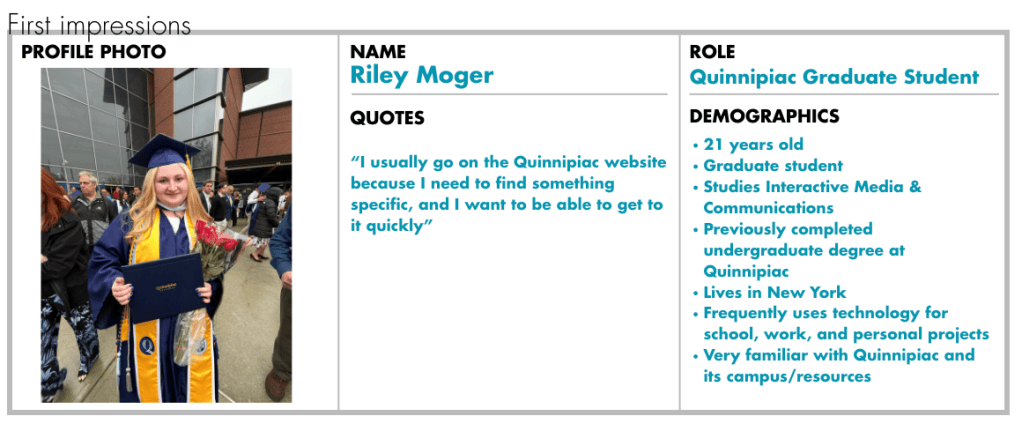
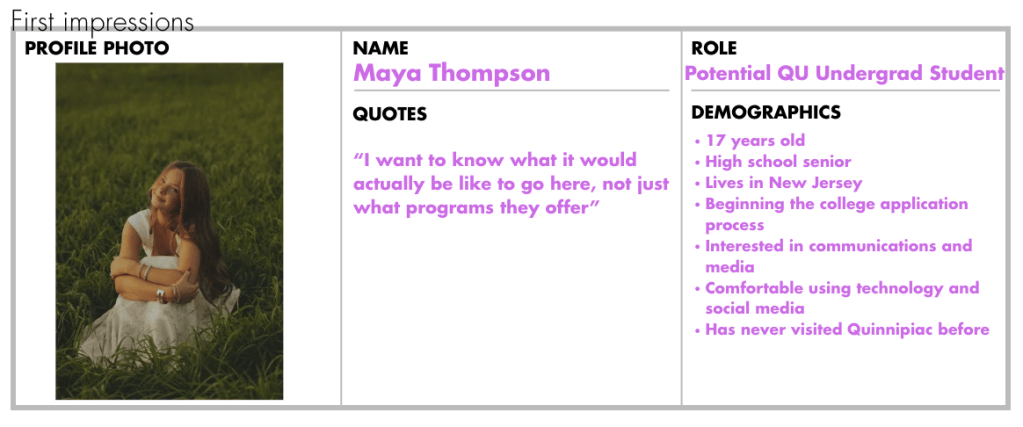
This week, I explored this idea by creating two user personas for the Quinnipiac University website. One persona was based on my own experience as a current Quinnipiac graduate student, while the other represented a potential undergraduate student who is just beginning her college search. Creating these personas helped me see how much a person’s background and reason for visiting a website can change their overall experience.
What Is a User Persona?
Before this module, I mostly thought of personas as profiles that described the type of person who might use a product or website. However, there is much more to them than simply just giving someone a name, age, and photo.
Personas are fake representations of specific people that help designers understand their needs, behaviors, motivations, and goals. The Interaction Design Foundation explains that personas represent groups of users who have similar needs and behaviors, helping designers keep the actual person at the center of the design process.
One thing that stood out to me from the readings was that the actual persona document is not necessarily the most important part. Smashing Magazine explains that personas are used to summarize and communicate research about users so designers can focus on designing for a specific type of person rather than a generic “everyone.” That became much clearer to me once I started creating my own.
Looking at Quinnipiac From Two Perspectives
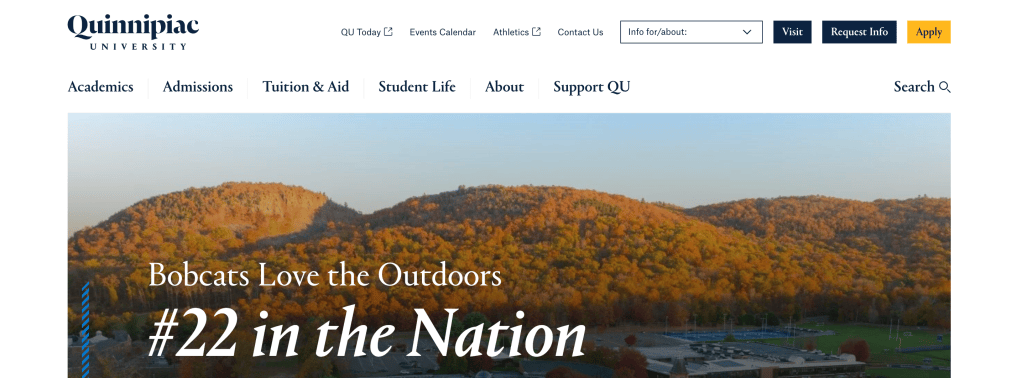
For my first persona, I used my own personal experience as a current Quinnipiac graduate student. I have already completed my undergraduate degree at Quinnipiac, so I am extremely familiar with the university and its terminologies. When I visit the Quinnipiac website, I am usually not there to explore because I already know what Quinnipiac is like, and it is a familiar interface. Instead, I normally have something specific that I need to find, such as an academic deadline, program information, university policy, event, or contact information.
My second persona, Maya Thompson, is a 17 year old prospective student who has never visited Quinnipiac before. Her experience is almost the complete opposite as mine. She is using the website to explore things such as different majors, campus life, housing, admissions requirements, tuition, financial aid, and tours while deciding whether Quinnipiac could be the right school for her or not.
This difference ended up being one of the most interesting parts of creating the personas. I might become frustrated if it takes several pages to find one piece of information because I want to complete my task quickly. Maya, on the other hand, may actually want to explore several pages because she is still learning about the university.
The Same Website Can Serve Very Different Goals
Creating the motivation and ability sections also made me think differently about these two users. My motivation and ability are both high because I usually have a reason for visiting the website and already understand how Quinnipiac works. Maya is also highly motivated, since choosing a college is a major decision, but her ability to navigate the information may be lower because everything is unfamiliar to her.
This connects to one of the ideas discussed by Digital.gov. That is that understanding an audience means looking at the journey they are taking and the tasks they are trying to accomplish, rather than only identifying basic characteristics about them.
The environments surrounding each user also matter. I might be checking the Quinnipiac website from my phone while I am on campus and need an answer quickly. Maya could be sitting at home on her laptop with multiple college websites open while talking to her family about her options. Even though we are looking at the same website, we are approaching it with completely different mindsets.
Designing Beyond Your Own Experience
The biggest thing I took away from this project is how easy it is to judge a website only from your own personal perspective. Because I have been at Quinnipiac for several years, I understand the different terminologies and information that might not be obvious to someone visiting the website for the first time.
Personas force designers to consider those differences. Smashing Magazine discusses how personas can help prevent designers from designing only for themselves by giving them a specific user’s goals and needs to consider. For a university website, this is especially important because there isn’t really one single “Quinnipiac website user.” Current students, prospective students, parents, alumni, faculty, and staff may all visit the same site for completely different reasons.
Creating these two personas showed me that a successful website needs to account for both types of experiences. A current student should be able to quickly locate specific information, while someone like Maya needs clear navigation and enough information to explore and understand what Quinnipiac has to offer.
Overall, this project made personas feel much more useful to me than simply creating a fictional user profile. By considering goals, motivations, environments, influencers, and behaviors, I was able to look at the same website from a perspective other than my own. That is ultimately what makes personas valuable: they encourage designers to stop assuming that every user thinks and behaves the same way they do.
Citations
Carden, F. (2023, May 19). Personas: Learn how to discover your audience, understand them, and pivot to address their needs. Digital.gov. Digital.gov article
Goltz, S. (2014, August 6). A closer look at personas: What they are and how they work, part 1. Smashing Magazine. Smashing Magazine article
O’Connor, K. (2011, March 25). Personas: The foundation of a great user experience. UX Magazine. UX Magazine article

 Riley In Context
Leave a comment