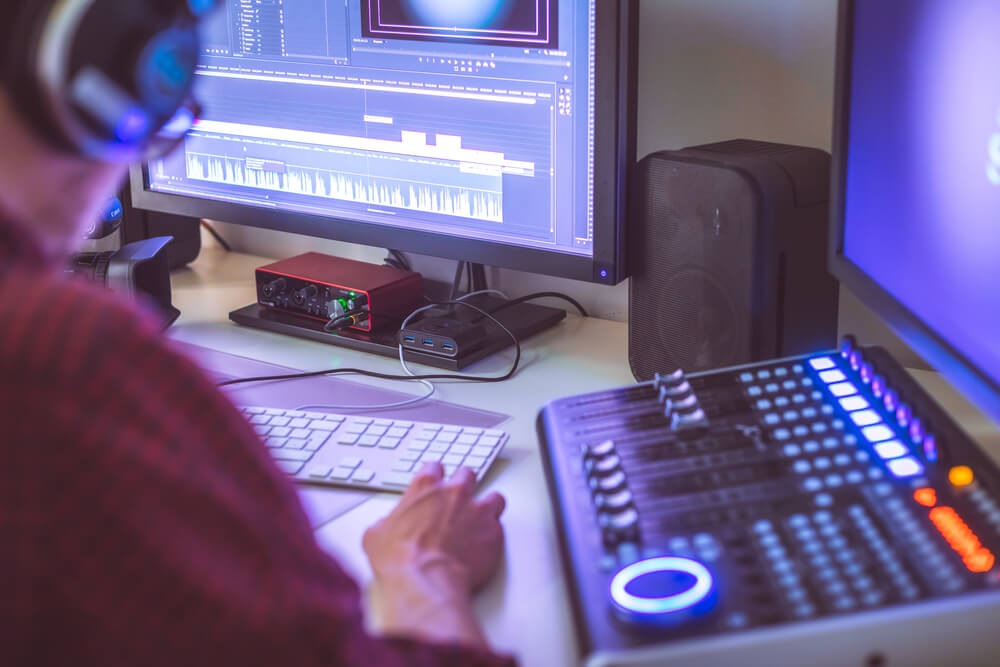
READING & WRITING
- The Bare Bones Camera Course for Film and Video (Chapter 8: Sound)
When I think about what makes a video good, my mind usually goes straight to the visuals and editing. However, Chapter 8 made me think more about the audio and everything that needs to happen before you even start putting a project together. Schroeppel explains how sound travels and how different microphones pick it up. An omnidirectional microphone captures sound from every direction, while directional microphones focus more on certain areas. Choosing a microphone is about understanding what you want your audience to hear and what else might get picked up around you.
Something that stood out to me was how much the space you record in can affect the final result. You could have a good microphone, but if you are in a room with a lot of hard surfaces, the sound can bounce around and create echoes. Things like carpets, blankets, and upholstered furniture can help reduce that. I also thought the advice about listening through headphones while recording was useful because it gives you a chance to catch distracting sounds before you finish. It is easy to focus on getting through what you want to say and forget to check how it actually sounds.
My biggest takeaway was to record voices, sound effects, and ambient audio separately so you have more control when editing. The chapter also discusses recording “presence,” which is the background sound of a location. I would not have thought about recording that on its own, but it makes sense that completely silent gaps could make an edit feel unnatural. For my podcast, I want to keep these details in mind so the audio feels connected and intentional. Music and sound effects can add a lot, but I need a clear voice recording to build everything around first.
1. “The Art of Creating an Invisible Podcast Episode Script“
Some of my favorite podcasts feel like I am just listening to people have a conversation, so it is easy to forget how much planning might happen beforehand. This article explains that an “invisible script” gives an episode structure without making it sound like the host is reading. That could mean using bullet points for the main discussion and writing out sections like the introduction and ending more carefully (Anderson, 2020).
Something that stood out to me was the advice to write the way you actually talk. A sentence might look good on a page but feel awkward when spoken out loud. Short sentences, familiar language, and contractions can help the delivery feel more natural. The article also emphasizes giving listeners a reason to keep listening at the beginning and following through on that throughout the episode. For my own podcast, I want to have a clear plan while still sounding like myself. I think reading my script aloud as I write will help me catch anything that feels too formal or unnatural.
2. “Creating a Great Podcast Script: 3 Methods Top Podcasters Use“
This article helped me understand that a podcast script does not have to look the same for everyone. Gray (2024) explains three approaches: writing everything word for word, creating a detailed outline, or using a loose bullet point plan. A full script can help you remember details and feel more prepared, but it can also make your delivery sound flat. A detailed outline gives you structure with some flexibility, while a shorter bullet point plan leaves more room to speak freely. However, that freedom can also make it easier to go off topic or forget something important.
What I found useful was the idea that you can choose how much structure you need based on your confidence and the material. For my own podcast, I think I would feel more comfortable starting with a detailed script, especially since the finished piece has a time limit. I could figure out what I want to say beforehand and then practice making it sound conversational. I also liked the suggestion to read sentences aloud while writing them. That would help me hear whether something sounds like me or needs to be reworded before I record.
3. “Podcast Taglines, Hooks, & the Power of Words“
This article made me think about how even a short phrase can help give a podcast its identity. Anderson (2024) explains that a tagline introduces the show and can tell listeners what they will get out of it. It does not have to be complicated to be memorable. A simple introduction that makes the purpose clear can be just as effective. With my background in advertising, I could connect this to how brands use taglines to help people recognize and remember them.
Something I found interesting was that hooks can also help guide listeners throughout an episode. The article describes them as similar to chapter headings because they signal different sections, like an interview or a closing call to action. That made me think more about how listeners follow a story when there are no visuals to guide them. For my own podcast, I want the opening to make the topic clear and give people a reason to stay. I also want any transitions to fit the tone of the piece so they feel natural when spoken aloud.
4. “Best Podcast Tools of 2026: Make, Market, & Monetise Your Show“
This article made the technical side of podcasting feel more approachable. McLean (2024) discusses tools for different parts of the process, including planning, recording, editing, and sharing episodes. Some examples include the Alitu Showplanner for developing ideas, microphones and recorders for capturing audio, and editing software for putting everything together. The article also includes a physical podcast planner, which shows that organizing a project does not always require another app.
What stood out to me was that you do not need every tool on the list to make a podcast. It is easy to get caught up in figuring out the perfect equipment or software before you have even started. For my own project, I want to focus on what will actually help me organize my ideas and record clear audio. I also thought EditPoint sounded useful because it lets you mark moments that need editing while listening back. Having a way to keep track of those details could make the editing process feel less overwhelming.
5. “Podcast Presentation Skills | Honing Your Speechcraft”
This article focuses on how you deliver your podcast and how that affects the listening experience. Cudmore (2020) explains that you can sound professional while still being friendly and conversational. One suggestion is to imagine speaking to one person instead of addressing a whole audience. The article also discusses pacing and pitch. Speaking too quickly can make it difficult for listeners to follow, while keeping the same tone throughout can make the delivery feel flat.
Something I liked was the reminder that making a mistake does not mean you have to start everything over. You can pause, find your place, and try the line again because those moments can be edited afterward. I think remembering that would take some pressure off recording. For my own podcast, I want to practice enough to feel familiar with the material without getting caught up in making every sentence perfect. I want my voice to sound interested in what I am talking about so listeners have a reason to feel interested too.
RESEARCH TO INFORM
1. Brooke and Connor Make a Podcast: “Sorry About This One | BNCMAP – Episode 231”
Brooke and Connor Make a Podcast is my favorite podcast of all time. I chose this specific episode because Brooke and Connor’s conversations are a big part of why I enjoy their podcast. In the clip I selected, the discussion turns into an exaggerated scenario about medieval times. Instead of moving straight to another topic, they keep adding details that take the joke further. That back-and-forth gives the conversation momentum and makes me want to hear what they will come up with next.
The format is a casual conversation between the two hosts, with the entertainment coming from how they respond to each other. This example made me think about how an engaging audio project needs room for personality. For my own podcast, I want to keep that conversational feeling in mind so my narration feels like I am sharing something with the listener.
2. 2. The Broski Report: “Love Island & Michelangelo”
I love Brittany Broski and everything she symbolizes. Especially, how she can go from unserious to something she is super passionate about in the matter of seconds. I chose this episode because Brittany takes a solo conversation into something personal and meaningful. I even recently made a video edit (on After Effects) using the section where she talks about letting go and looking forward to who she will become. What interested me was the progression of that moment. She starts by acknowledging how difficult change can be, then moves toward the possibilities that come afterward. That gives the discussion an emotional direction and a reason to keep following her thoughts.
Unlike Brooke and Connor’s two-host conversation, this example centers on one person sharing her perspective directly with the audience. The personal wording makes the discussion feel less like a formal presentation and more like something a friend might tell you. For my own podcast, I want to use that sense of direct connection and give my narration a clear progression, so listeners have something to take away from the ending.
3. The Comment Section: “Doing Blasphemy” (Ft. Caleb Hearon)
I am a big Drew Afualo fan, specifically for the way she gives her interviewee a platform. I chose this episode because her guest, Caleb can turn an everyday observation into an entire story. In the clip I selected, he talks about trying to find the Spotify offices, and then walks through H&M, adding details about the store and imagining the people inside it. Those specific details give the audience something to picture without needing to see what he is describing. The story keeps developing instead of giving everything away immediately, which makes me want to hear where he is going with it.
The host-and-guest format also gives Caleb space to tell his story while Drew responds and becomes part of the conversation. It feels more casual than a strict question-and-answer interview. For my own podcast, I want to remember how useful specific descriptions can be. Since listeners will not have visuals, the words I choose need to help them imagine the situation and feel connected to what I am saying.
CREATE
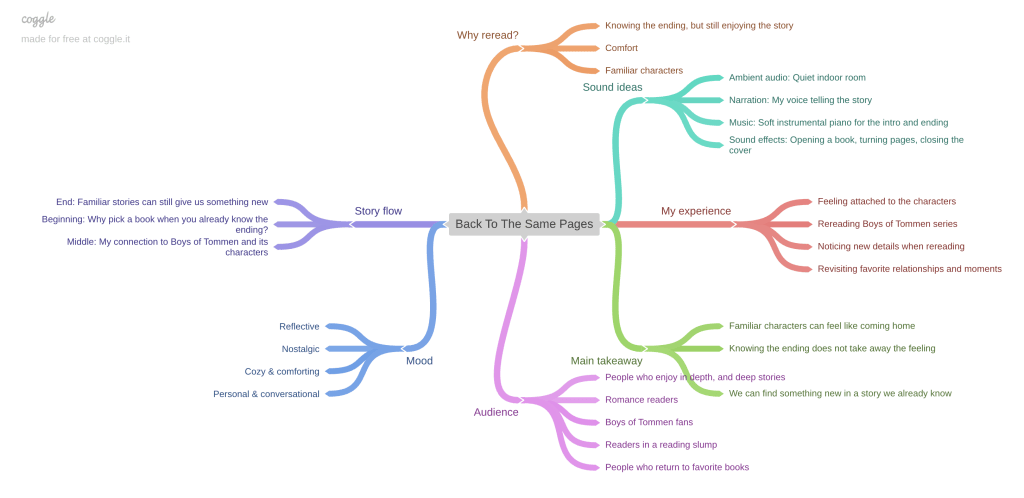
For my podcast, “Back to the Same Pages,” I decided to explore why we return to books when we already know what happens. I chose this topic because of my connection to the Boys of Tommen series and how attached I feel to its characters. I wanted to focus on that experience rather than create a book review or summarize the plots.
Creating the mind map helped me connect my ideas and figure out a beginning, middle, and end. The planning document pushed me to think beyond what I wanted to say and consider what listeners would hear. I plan to use soft piano music, quiet room ambience, and separately recorded book sounds to create the feeling of settling into a familiar reading space.
One challenge will be making my narration sound natural while following a script. I also want to explain my connection to the series in a way that makes sense to someone who has never read it, without giving away major spoilers. When editing, I will need to balance the music and sound effects so they support my voice and give the reflective moments room to breathe.
CITATIONS
Anderson, K. (2020, August 1). The art of creating an invisible podcast episode script. The Podcast Host. https://www.thepodcasthost.com/planning/the-invisible-podcast-script/
Anderson, K. (2024, June 14). Podcast taglines, hooks, & the power of words. The Podcast Host. https://www.thepodcasthost.com/planning/hooks-taglines-power-of-words/
Cudmore, R. (2020, November 2). Podcast presentation skills | Honing your speechcraft. The Podcast Host. https://www.thepodcasthost.com/presenting-your-podcast/podcast-presentation-skills/
Gray, C. (2024, January 10). Creating a great podcast script: 3 methods top podcasters use. The Podcast Host. https://www.thepodcasthost.com/planning/podcast-scripting/
McLean, M. (2024, April 3). Best podcast tools of 2026: Make, market, & monetise your show. The Podcast Host. https://www.thepodcasthost.com/planning/best-podcast-tools/
Schroeppel, T. (2015). The bare bones camera course for film and video. Allworth Press.


Leave a Reply