
When designing a product or experience, it can be easy to assume that we already know what people want. We might think we understand a user’s problem because we possibly have experienced something similar ourselves. The problem is that our own experiences are not always the same as what someone else’s are.

Therefore, this is where the empathy research comes in. Empathy is an important part of design thinking because it helps designers understand the people they are designing for instead of simply just making assumptions about them. In his Ted Talk, Tim Brown even describes design thinking as a more human-centered approach to design, where understanding people’s needs, culture, and context is an important part of the process.
There are many different ways researchers can develop this understanding. Some methods involve directly observing people, while others allow users to document their own experiences. With that being said, I picked five empathy research methods that can help designers get a better understanding of the people they are designing for.
1. Asking What-How-Why

One of the simplest empathy research methods, in my opinion, is the What-How-Why method. It involves observing someone and breaking the observation into three important questions. 1. What are they doing? 2. How are they doing it? 3. Why might they be doing it?
The “What” focuses on the facts of the situation without making any assumptions. The “How” looks more closely at the person’s behavior and emotions. Finally, the “Why” asks what might be motivating that behavior. The Interaction Design Foundation explains that this method allows researchers to move from concrete observations toward possible emotional driven motivations.
For example, imagine a designer is researching how college students study. The “What” could be that a student is sitting at their desk with a laptop, textbook, and several tabs open. The “How” could be that they keep switching between different websites, constantly picking up and checking their phone, and also highlighting important things in their textbook. The “Why” might be that the student feels overwhelmed by the work and is having trouble figuring out where to start. The important part is that the researcher does not immediately assume that the student is disorganized or lazy. Instead, they use their observations to ask deeper questions about what could be causing the behavior.
This method is useful because sometimes the most important information is not what a person says, but what they actually do.
2. Personal Photos and Video Journals
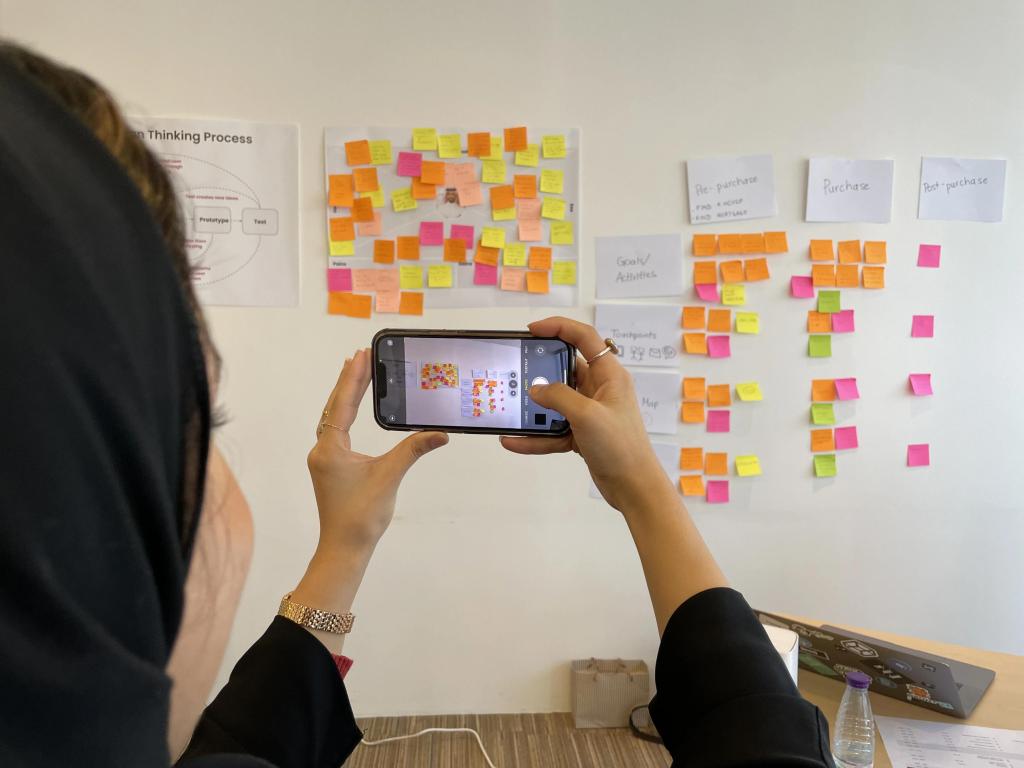
Another method is personal photos and video journals, where participants document their own experiences through photos or videos.
Instead of having a researcher follow someone around for research, the participant gets to document their everything themselves. They might be asked to take pictures throughout a normal day or record specific moments related to the problem that is being researched. The researcher can then use these photos and videos to better understand the person’s environment and experiences.
For example, imagine a banking company wants to improve the experience of using a mobile banking app. Participants could be asked to take screenshots or short videos when they use the app during a normal week. They could document moments that are confusing, frustrating, convenient, or even surprisingly easy.
This could reveal things that might not come up in a traditional interview. A participant might not think to mention that they usually use the app while they are walking around, for example. A photo or video could show that they are trying to use the app one-handed while carrying groceries, or shopping, which creates a completely different context for the designer to consider.
One of the biggest advantages of this method is that researchers get to see the user’s experience in their actual environment. It can also give participants time to think about their experiences before discussing them with a researcher.
3. Story Share-and-Capture
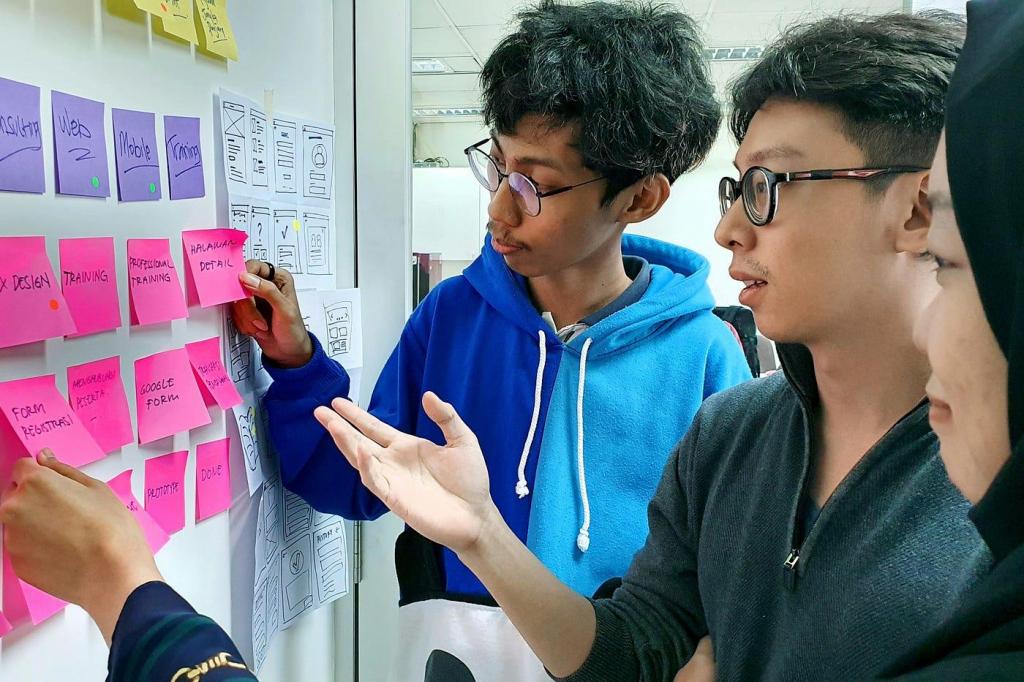
Sometimes, the best way to understand someone’s experience is simply to let them tell the story. That is where story share-and-capture comes in and becomes important. It involves researchers sharing observations from their fieldwork in the form of stories. Instead of only focusing on individual facts or statistics, researchers can talk about specific experiences they witnessed and the details that stood out to them.
For example, imagine a university is researching the experience students have when meeting with academic advisors. Instead of only asking students to rate their appointment from one to five, a researcher could ask them to tell the story of their most recent advising appointment.
A student might explain that they were nervous before the meeting, didn’t know what questions to ask, felt like the advisor was rushing them, and then left still confused about what classes they should take. That one personal story gives the researcher a lot more information than a rating. It shows the student’s emotions, expectations, frustrations, and specific moments that shaped their experience.
Storytelling can also help research teams find patterns. If multiple researchers come back from different interviews with similar stories, they might realize that the problem is bigger than one person’s experience.
4. Empathy Mapping
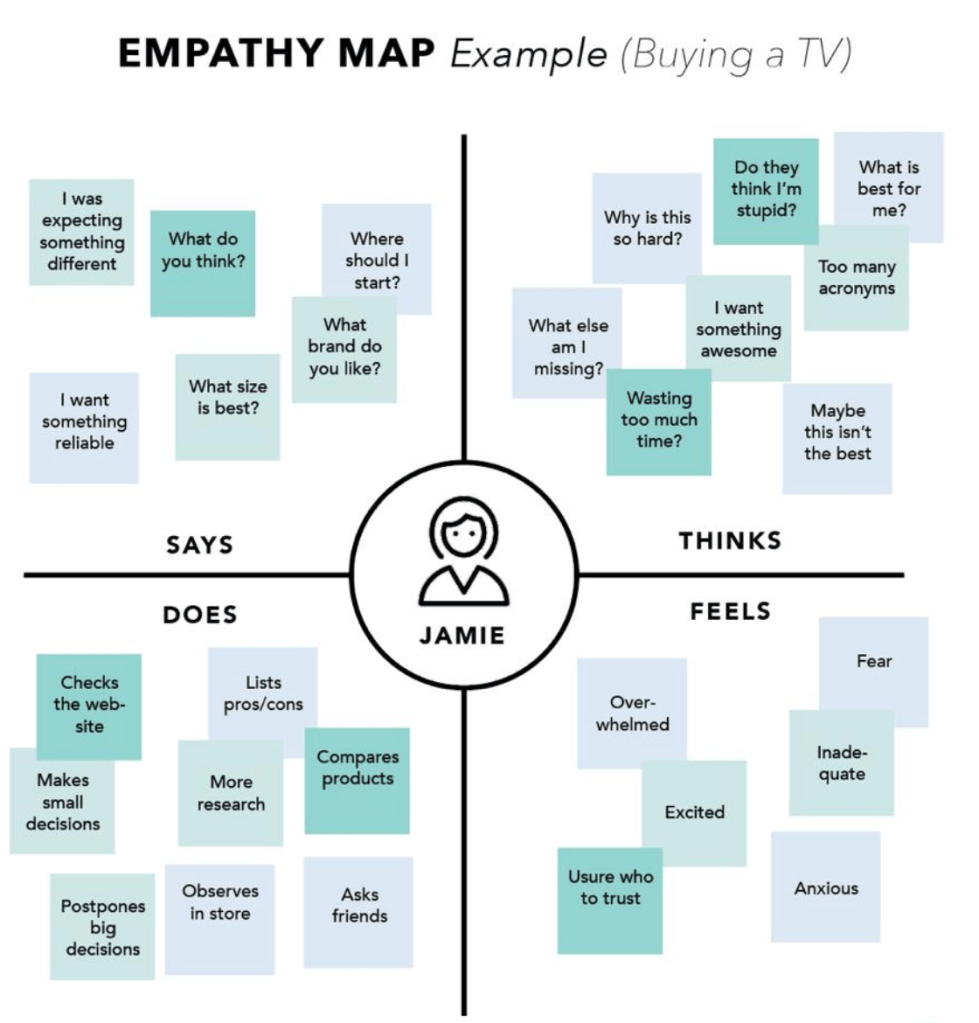
Next, Empathy mapping takes information collected during research and organizes it into a visual format. A traditional empathy map is divided into four sections of “Says, Thinks, Does, and Feels.”
For example, if a team is researching about someone using a food delivery app, the map might look something like this.
Says: “I don’t know which restaurant to choose.”
Thinks: “I hope my food gets here on time.”
Does: Checks the delivery tracker multiple times.
Feels: Impatient and unsure.
The point is not to randomly guess what someone is thinking or feeling. Instead, the map should be based on information collected through research, such as interviews, observations, photos or videos. Researchers can then use the map to identify patterns and gaps in what they know about the user.
I think this method is especially useful because it turns a lot of research into something that is easy for a design team to look at and understand. Someone who did not participate in the original interview can look at the map and quickly get a better idea of what the user is experiencing.
5. Journey Mapping
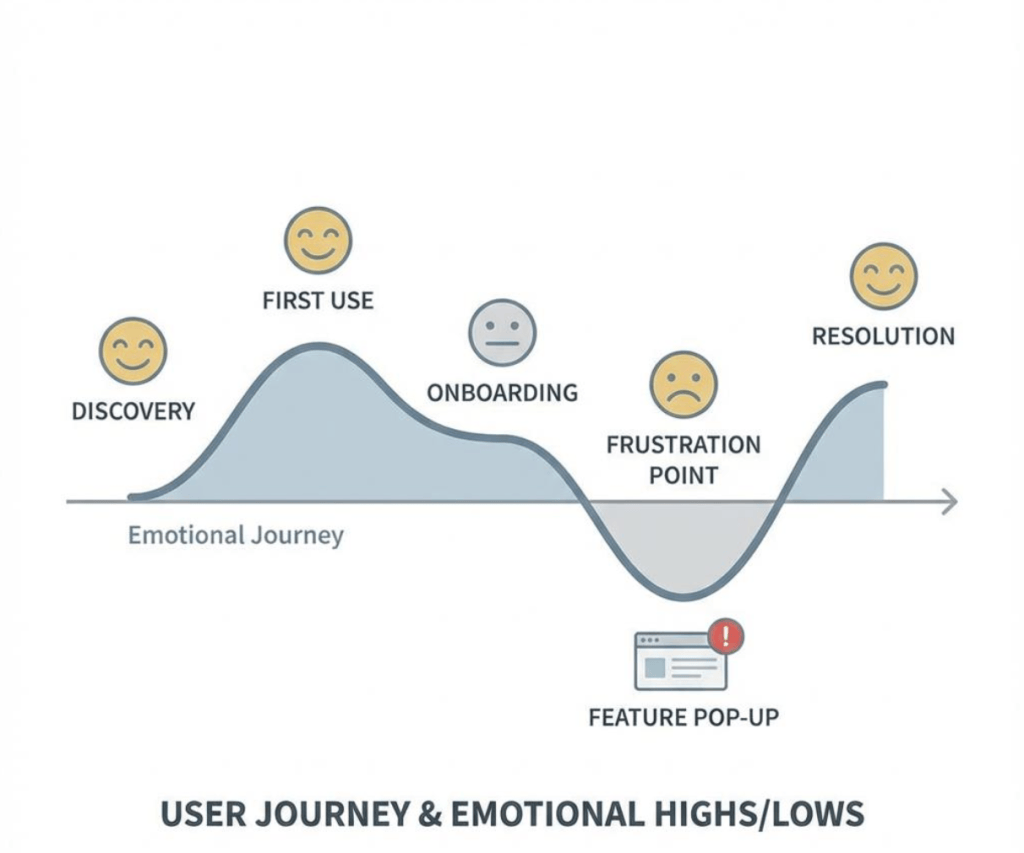
The final method for this is journey mapping, which focuses on the different stages of an experience.
Instead of looking at one specific interaction, a journey map follows the user through an entire process. It can show what the user is doing, thinking, and feeling at different points along the way. Journey mapping can help researchers identify where people are having the most difficulty or where there are opportunities to improve the experience.
For example, if we are still thinking about ordering food through a delivery app you would go through this process: choose what to eat -> search for restaurants -> pick a restaurant -> place the order -> wait -> receive the food.
Each step can have a different emotional experience. Choosing a restaurant might be exciting, while comparing dozens of options could quickly become overwhelming. Placing the order might feel easy, but waiting for the food could create frustration if the delivery time keeps changing.
Looking at the entire journey helps designers see that the user’s experience is not just about whether the final product works. Every step leading up to it matters too.
Why Empathy Research Matters
All five of these methods have something in common. That is that they help designers move beyond just assumptions.
A survey might tell a designer that someone is frustrated. An empathy research method can help explain why they are frustrated and what is happening when that feeling occurs. Observing behavior, listening to stories, documenting experiences, and mapping emotions can reveal details that might otherwise be missed.
This connects back to the larger idea of design thinking. Good design is not just about creating something that looks good. As Tim Brown explains in his Ted Talk, design thinking is about taking a human-centered approach and understanding the people, situations, and contexts involved.
Empathy research gives designers a way to actually do that. Instead of designing what we think people need, we can spend time understanding what they are experiencing first. That small change in perspective can make a huge difference in the final design.
Citations
Brown, T. (2009). Designers—think big! TED Conferences. https://www.ted.com/talks/tim_brown_designers_think_big
Brown, T. (2008). Design thinking. Harvard Business Review, 86(6), 84–92.
Interaction Design Foundation. (2021). Design thinking: Getting started with empathy. https://www.interaction-design.org/literature/article/design-thinking-getting-started-with-empathy
Interaction Design Foundation. (2021). 5 stages in the design thinking process. https://www.interaction-design.org/literature/article/5-stages-in-the-design-thinking-process
Nielsen Norman Group. (2024). Empathy mapping: The first step in design thinking. https://www.nngroup.com/articles/empathy-mapping/
Wiecek, A. (2021). 9 best empathic research methods to help you dig deeper & truly understand your customers. Medium. https://medium.com/@alewiecek/9-best-empathic-research-methods-to-help-you-dig-deeper-truly-understand-your-customer-5a9b56c45e59
Kelley, T., & Kelley, D. (2013). Empathize with your end user. Slate. https://slate.com/human-interest/2013/11/empathize-with-your-end-user-creative-confidence-by-tom-and-david-kelley.html

 Riley In Context
Leave a comment