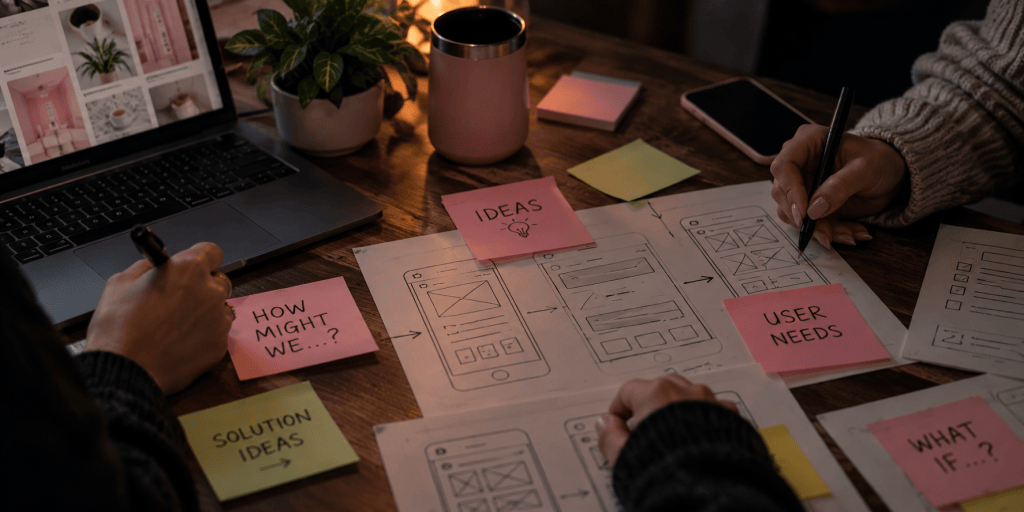
When I first think about coming up with solutions to a problem, my mind immediately goes to brainstorming. You identify the problem, start listing ideas, and eventually choose the one that seems the best. But after learning more about ideation, I realized that there are so many different ways to approach the exact same problem.
Ideation is an important part of the UX design process because it encourages designers to explore a variety of possible solutions before deciding which direction to take. Instead of getting attached to the first good idea, the goal is to generate different possibilities and look at a problem from multiple perspectives. Nielsen Norman Group explains that ideation focuses on generating a large quantity of ideas before narrowing them down (Harley, 2017).
For this project, I put that idea into practice using six Point of View (POV) statements I previously created from user reviews of Pinterest, Goodreads, and TikTok. Each POV represented a real frustration or need that I found in the reviews. This time, instead of just identifying those problems, I used different ideation techniques to think about how they could potentially be solved.
One Problem Can Have A Lot of Solutions
One of the biggest things I learned from this process is that the technique you use can completely change the ideas you come up with.
Some methods felt more natural to me. Brainstorming allowed me to write down whatever solutions came to mind without worrying about whether every idea was realistic. Mind mapping helped me take a larger problem and break it into smaller areas. Other methods forced me to think about problems in ways I normally wouldn’t.
SCAMPER, for example, uses prompts like Substitute, Combine, Adapt, Modify, Put to another use, Eliminate, and Rearrange to reconsider parts of an existing experience (Interaction Design Foundation, 2026). Instead of simply asking myself how I would fix something, I had specific questions that pushed me toward different possibilities.
Then there was Worst Possible Idea, which was probably one of the strangest methods at first. Instead of trying to solve a problem, I intentionally thought about ways I could make the experience worse. Once I had those ideas, I could reverse them and think about what users would actually want.
Turning Frustrations Into Features
What made this project interesting was using these techniques on apps that I already knew.
For Pinterest, one of my POV statements focused on users who want to find inspiration without constantly being interrupted by advertisements. After brainstorming different possibilities and using SCAMPER, one idea I came up with was an “Inspiration Mode.” This could temporarily reduce the number of advertisements shown while someone is actively searching or browsing for ideas.
Another Pinterest problem focused on organizing saved Pins. For that one, I used Crazy 8s to quickly come up with eight possible solutions. Some were simple, like adding a “Recently Saved” section, while others included automatic organization, board filters, bulk organization, and the ability to search within individual boards.
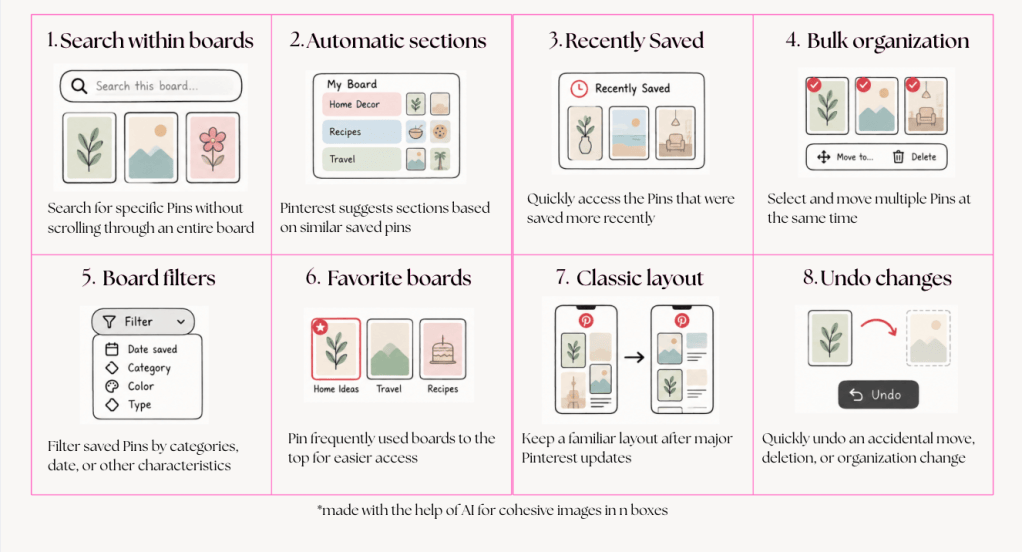
The search feature ended up being the idea I would want to pursue further. Someone who has hundreds of saved Pins might remember exactly what they saved but have absolutely no idea where they put it. I have definitely experienced that problem before, which made the solution feel especially practical.
Sometimes the Simplest Idea Works Best
Goodreads gave me a completely different type of problem to work with.
One of the user needs I identified was a more accurate way to rate books. Goodreads currently uses whole-star ratings, which can make it difficult when a book feels somewhere between two ratings. For this POV, I experimented with Worst Possible Idea and analogies.
I considered everything from a 10-point rating scale to percentages, reaction labels, category ratings, and mood tags. But after generating all of those possibilities, the idea I liked most was also one of the simplest: half-star ratings.
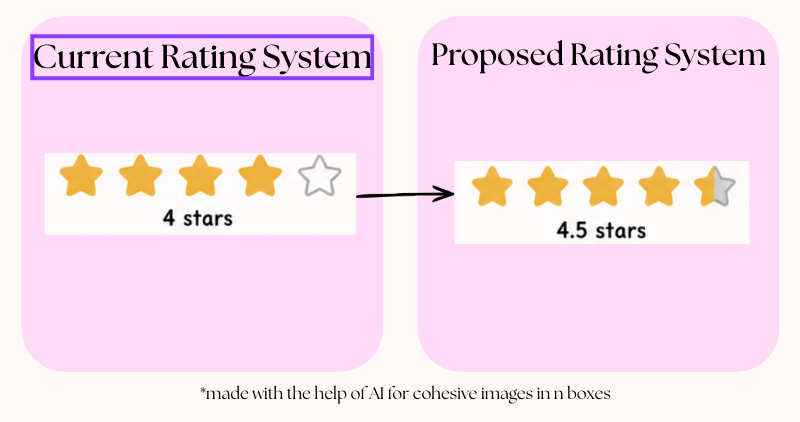
Adding half stars would keep the rating system users already understand while giving them a little more flexibility. Sometimes a book is simply not a four, but it is definitely not a five either.
Seeing the Experience Through the User’s Eyes
Out of all the techniques I tried, storyboarding was my favorite.
For one of my TikTok POV statements, I focused on how frustrating it can be to find a video you saved months ago. I imagined a user who remembers saving a book recommendation but has no idea which collection it is in.
I created a storyboard showing the user opening their saved content, struggling to find the video, discovering a proposed search bar, searching “book recommendation,” and finally finding the video they wanted.
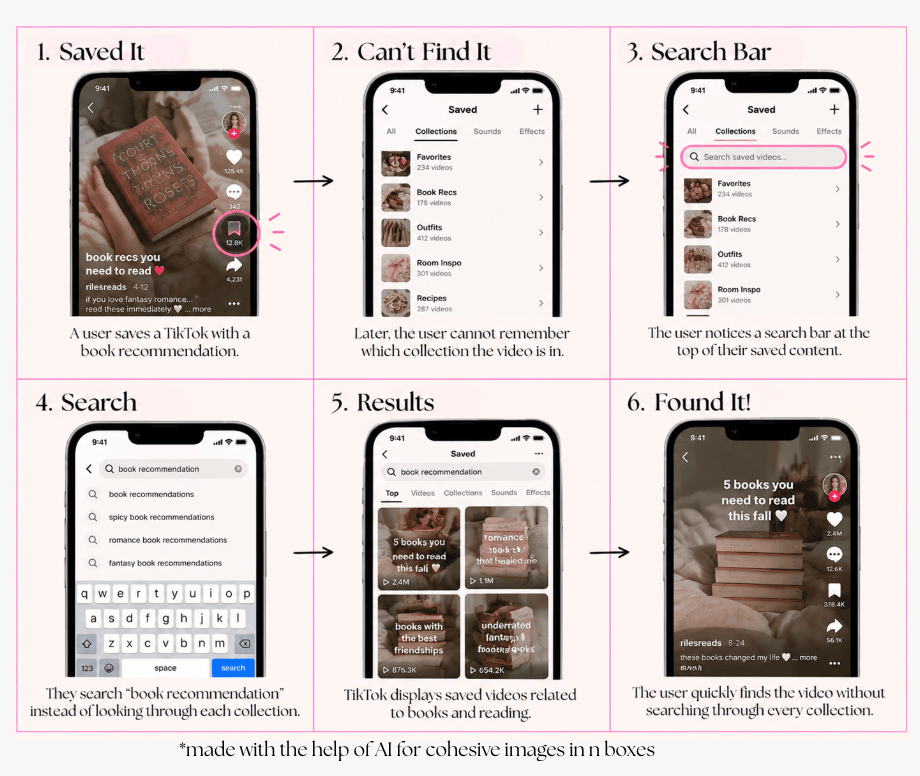
Storyboarding made the idea feel more realistic because I wasn’t only thinking about what the feature would look like. I was thinking about what happened before the user needed it, how they would interact with it, and whether it actually solved their problem. Storyboards can help UX designers visualize an experience as a sequence of events and understand how a user may interact with a potential solution (Krause, 2018).
Ideation Is About Exploring Before Deciding
The biggest thing I took away from this project is that ideation isn’t necessarily about immediately finding the perfect solution. It is about giving yourself enough possibilities to find a solution worth exploring further.
Using different techniques stopped me from automatically settling on my first idea. Some methods gave me ideas I probably would have come up with anyway, while others pushed me toward solutions I would not have considered on my own.
Not every idea generated during ideation needs to become an actual product feature, either. That’s kind of the point. You can generate eight ideas, twenty ideas, or even some intentionally terrible ideas before deciding which ones deserve more attention.
For my project, ideas like Pinterest’s Inspiration Mode, Goodreads half-star ratings, TikTok saved-video search, and TikTok connection recovery stood out as concepts I would want to explore further. The next step would be prototyping and testing those ideas with users to see whether they actually solve the problems they were designed to address.
Ideation showed me that solving a UX problem isn’t always about having one great idea. Sometimes, you need a lot of ideas to figure out which one is actually great.
View my full ideations here:
Citations
Harley, A. (2017, January 15). Ideation for everyday design challenges. Nielsen Norman Group.
https://www.nngroup.com/articles/ux-ideation/ Nielsen Norman Group
Interaction Design Foundation. (n.d.). What is ideation?
https://www.interaction-design.org/literature/topics/ideation WAC
Krause, R. (2018, July 15). Storyboards help visualize UX ideas. Nielsen Norman Group.
https://www.nngroup.com/articles/storyboards-visualize-ideas/


Leave a comment